TWO:It was very quiet and still there when once the gates were closed. Balmayne took one of the lamps from the motor and extinguished the other. In the centre of the place was the well, partially covered over by a flat stone. There was a windlass, but no rope. Balmayne produced one. Very carefully he fitted it to the windlass. His dark eyes gleamed and dilated.
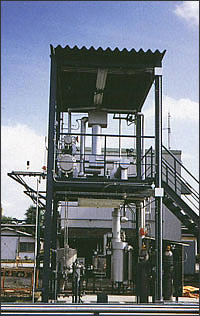
Great attention is recently being paid to global environmental issues, and it is now conceivable that companies will need to treat used solvents themselves. In consideration of this kind of social issue, we have developed a “membrane separation type solvent dehydration system,” which uses a polyimide membrane with superior dehydration properties developed by Ube Industries, Ltd. in combination with our own distillation and concentration technology that has resulted in solvents being more easily recovered.
THREE:"Must attend the inquest, sir," said the practical Prout. "Still, if that was my house, I'd pull it down if I couldn't sell it."("Voluntary workmen will be enrolled from August 21st on the left bank of the Meuse, where details of the conditions will be made known.")
- 1Under the distillation system, even in case of azeotropic solvent compositions, this system which remove water vapor by the polyimide membrane will easily dehydrate.
- 2In comparison with the distillation system, it significantly saves on use of steam.
- 3Dehydration can be performed through merely supplying evaporated vapor to the membrane module and maintaining the differential pressure between the permeable side and the impermeable side.
- 4Solvent purity of 99.9% or more can be achieved by carrying out dehydration with a polyimide membrane only.
- 5The polyimide membrane has superior heat and solvent resistance. Therefore, the vapor permeation system reduces contamination of the membrane and thus extends its life.
THREE:
The aromatic polyimide membrane is highly permeable to water vapor but less permeable to vapors of organic compounds such as alcohol etc.
THREE:"Private motor-cars, motor-bicycles, and bicycles are only allowed to move about in the districts occupied by the German army if driven by German soldiers, or the chauffeur possesses a licence. These licences are only issued by the local commanders, and only in urgent cases. The motor-cars, motor-bicycles, and bicycles will be seized if this rule is infringed. Anyone who tries to push through the German outposts shall be shot at, as also anyone who approaches them in such a manner that he seems to be a spy.
- 1 Recovery of the detergent solvent Recovery of the cleaning solvent such as electronic parts industry, precision instrument industry.
- 2Solvent recovery and the refinement Solvent recovery and the refinement such as chemical industry, an industry of medical supplies, food industry, the fermentation industry.
THREE:CHAPTER XV. LAWRENCE PROPHESIES AGAIN.With the idea of subsumption and subordination to law, we pass at once to the Stoic ethics. For Zeno, the end of life was self-consistency; for Cleanthes, consistency with Nature; for Chrysippus, both the one and the other.42 The still surviving individualism of the Cynics is represented in the first of these principles; the religious inspiration of the Stoa in the second; and the comprehensiveness of its great systematising intellect in the last. On the other hand, there18 is a vagueness about the idea of self-consistency which seems to date from a time when Stoicism was less a new and exclusive school than an endeavour to appropriate whatever was best in the older schools. For to be consistent is the common ideal of all philosophy, and is just what distinguishes it from the uncalculating impulsiveness of ordinary life, the chance inspirations of ordinary thought. But the Peripatetic who chose knowledge as his highest good differed widely from the Hedonist who made pleasure or painlessness his end; and even if they agreed in thinking that the highest pleasure is yielded by knowledge, the Stoic himself would assert that the object of their common pursuit was with both alike essentially unmoral. He would, no doubt, maintain that the self-consistency of any theory but his own was a delusion, and that all false moralities would, if consistently acted out, inevitably land their professors in a contradiction.43 Yet the absence of contradiction, although a valuable verification, is too negative a mark to serve for the sole test of rightness; and thus we are led on to the more specific standard of conformability to Nature, whether our own or that of the universe as a whole. Here again a difficulty presents itself. The idea of Nature had taken such a powerful hold on the Greek mind that it was employed by every school in turn¡ªexcept perhaps by the extreme sceptics, still faithful to the traditions of Protagoras and Gorgias¡ªand was confidently appealed to in support of the most divergent ethical systems. We find it occupying a prominent place both in Plato¡¯s Laws and in Aristotle¡¯s Politics; while the maxim, Follow Nature, was borrowed by Zeno himself from Polemo, the head of the Academy, or perhaps from Polemo¡¯s predecessor, Xenocrates. And Epicurus, the great opponent of Stoicism, maintained, not without plausibility, that every19 animal is led by Nature to pursue its own pleasure in preference to any other end.44 Thus, when Cleanthes declared that pleasure was unnatural,45 he and the Epicureans could not have been talking about the same thing. They must have meant something different by pleasure or by nature or by both.
Acetone, ethanol, methyl ethyl ketone, butanol, isopropyl alcohol, ethyl acetate, methyl isobutyl ketone, others (including hexane and toluene).
